
E-Challan Check
Earn Money in Pakistan in 2026
The e-challan 92e system 666a in Punjab is a digital traffic fine system introduced to monitor and penalize traffic violations without using traditional paper tickets. It is managed by the Punjab Safe Cities Authority (PSCA), which uses Safe City cameras installed in major cities to automatically detect violations on the road.
Have you PK365 received an SMS about a traffic violation but are unsure how much you need to pay? In Punjab, the e-challan system has been upgraded to digitally track every traffic rule violation through Safe Spinwinpk cameras in major play rupees register cities.Users check pk365 game for latest updates and app features.8Bet and Y888
Punjab’s traffic monitoring is rs33 managed by the m666 PSCA Punjab Pkr98 Game Safe Cities , Win786 game Authority, Winpkr loginwhich automatically pk365 records violations such as t7777 game signal jumping, betpkr wrong K555.com.pk, not 67uu a helmet overspeeding. Drivers are advised to 883v regularly check their e-challan status to avoid penalties, increased fines, or even restrictions on vehicle registration under updated enforcement policies introduced in recent years.Checking your challan is now easier than ever thanks to e challan Punjab Website. It makes sure you get all the information on your phone from the comfort of your home, we also suggest checking out Pakwin for digital entertainment on your phone.
With the E-Challan Check Online system, residents of Lahore, Rawalpindi, Faisalabad, Multan, Gujranwala, and Sialkot can instantly view their pending traffic fines by entering their vehicle registration number and CNIC on the official PSCA portal.

What Is E-Challan System in Punjab?
The e-challan system in Punjab is a digital traffic fine system introduced to monitor and penalize traffic violations without using traditional paper tickets. It is managed by the Punjab Safe Cities Authority (PSCA), which uses Safe City cameras installed in major cities to automatically detect violations on the road.
What Did Chief Minister Announce on December 2, 2025? Latest Update
When a driver breaks a traffic rule—such as signal jumping, over-speeding, wrong parking, or not wearing a helmet—the system captures the violation through cameras and generates an electronic challan linked to the vehicle’s registration number and CNIC. The owner receives a notification on their registered mobile number.
All violation records are stored digitally and can be accessed through official online portals. The system is also connected with the DLIMS (Driving License Issuance Management System), ensuring a permanent record of traffic history. This helps authorities improve road discipline and makes the process more transparent, fast, and paperless across Punjab.
On December 2, 2025, the Chief Minister of Punjab highlighted a stronger push toward digital governance and strict law enforcement reforms across the province. The main focus was on improving public service delivery through technology and making government systems more transparent, fast, and efficient.
A key part of these developments was the expansion of digital monitoring systems used for traffic control, public safety, and rule enforcement. The government emphasized strengthening automated systems like e-challan, where violations are recorded in real time through surveillance cameras instead of manual ticketing.
This update also reflected Punjab’s broader plan to modernize administration by using smart systems for enforcement and citizen services. The goal is to reduce manual errors, improve road safety, and ensure quicker action against violations across major cities of Punjab.
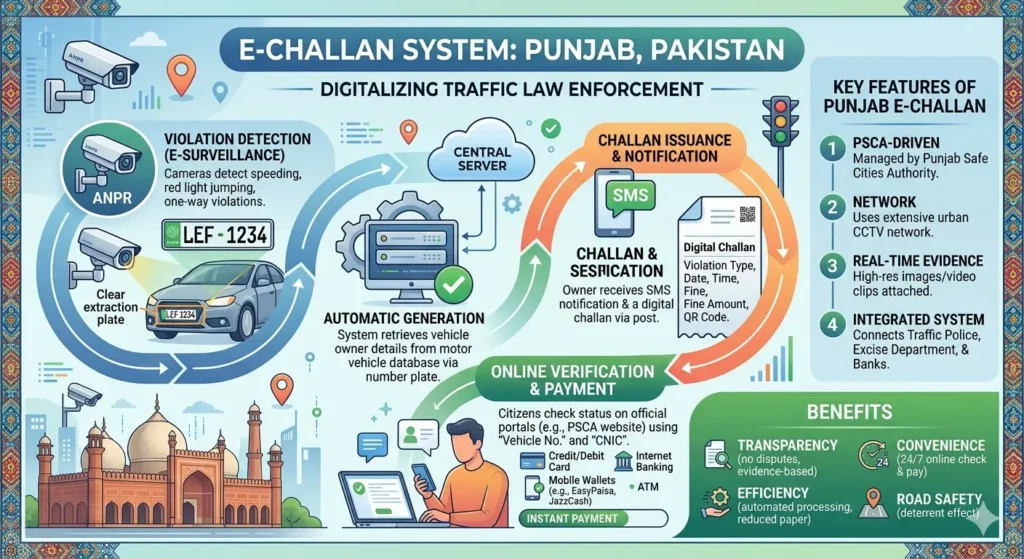
How Punjab E-Challan System Works?
The Punjab e-challan system works through a fully automated digital surveillance network managed by the Punjab Safe Cities Authority (PSCA). High-definition Safe City cameras installed on roads, intersections, and highways continuously monitor traffic movement in major cities like Lahore, Rawalpindi, Faisalabad, and Multan.
When a driver violates a traffic rule such as signal jumping, speeding, wrong parking, or not wearing a helmet the system automatically captures the vehicle’s image, records the location, date, and time, and generates an electronic challan linked to the vehicle’s registration number and CNIC. This process removes the need for physical traffic officers to issue paper tickets.
Once generated, the e-challa Checkn is sent to the vehicle owner’s registered mobile number and is also stored in the digital database connected with the DLIMS (Driving License Issuance Management System). This ensures that every violation becomes part of a permanent driving record, which can affect vehicle token renewal, license status, and legal compliance if not cleared on time.
Why E-Challan Check Matters Now?
Chief Minister Punjab Maryam Nawaz Sharif has enforced stricter traffic laws from December 1, 2025. The new system is designed to reduce road accidents, improve driving discipline, and ensure full compliance with traffic rules across Punjab province.
Every traffic violation is now automatically recorded through the Safe City surveillance network and stored as a permanent digital record in your DLIMS profile managed by the DLIMS (Driving License Issuance Management System). This directly impacts several aspects of vehicle ownership and driving rights.
License Renewal Issues:
Multiple unpaid e-challans can delay or block your driving license renewal. The system checks your complete violation history before approving any renewal application.
Token Tax Problems:
Excise and Taxation departments verify challan clearance before issuing or renewing vehicle tokens. Any unpaid fines can stop annual registration renewal.
Insurance Complications:
Some insurance companies review driving records during policy renewal. A history of repeated violations may affect premium rates or even coverage approval.
Checkpoint Stops:
Traffic police can instantly access the e-challan database at checkpoints. Officers can view pending fines on the spot and take immediate action if violations are unpaid.
Vehicle Impoundment Risk:
In serious cases where fines accumulate and remain unpaid, authorities may impose penalties that can lead to vehicle impoundment or legal action under Punjab traffic regulations.
With this fully digital system, hiding violations is no longer possible. Every traffic rule break remains linked to your record until it is properly cleared through payment.
How to Check E-Challan Online? Step-by-Step Process for Citizens of Punjab
Checking your Punjab e-challan is quick, simple, and fully online. The system is managed by the Punjab Safe Cities Authority, allowing citizens to instantly view traffic fines from home without visiting any office.
Follow these easy steps to check your e-challan accurately:
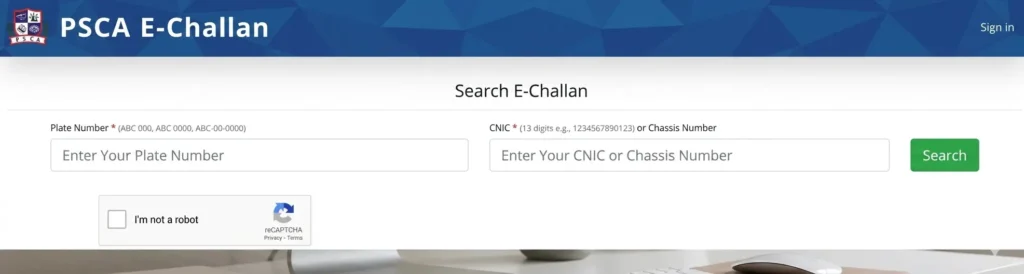
Step 1: Visit Official Portal
Open your browser and go to the official PSCA e-challan website:
This is the only trusted platform for checking fines. Always avoid fake or third-party websites to protect your personal data.
Step 2: Enter Vehicle Registration Number
Type your complete vehicle registration number in the required field. Make sure you enter it exactly as written on your number plate, including letters and numbers (for example: LHE-19-1234, RWP-456, or FSD-20-7890).
Step 3: Provide CNIC or Chassis Number
Enter your 13-digit CNIC number without dashes or spaces, or you can use your vehicle’s chassis number. This step helps the system match your vehicle with the correct owner record.
Step 4: Complete Security Verification
Tick the “I’m not a robot” box. This security check ensures the system is protected from automated or fake searches.
Step 5: Click on Search Button
Press the search button to process your request. The system will quickly retrieve your vehicle’s violation history.
Step 6: View Your E-Challan Details
Your complete record will appear on the screen, including all pending and paid challans. Each entry shows violation type, date, time, location, fine amount, and payment status. For camera-based violations, photographic evidence is also displayed.
To stay safe from penalties and legal issues, it is recommended to check your e-challan status at least once every month.
Understanding Your E-Challan Details
Every e-challan issued in Punjab contains important digital information that helps drivers understand what violation occurred, when it happened, and how it can be resolved. These records are generated and maintained through the system managed by the Punjab Safe Cities Authority.
Challan Number:
This is a unique identification number assigned to each violation. It is used for tracking, verification, and payment processing of the e-challan.
Violation Type:
This shows the exact traffic rule you broke. Common violations include signal jumping, overspeeding, wrong parking, lane violations, no helmet, and mobile phone usage while driving.
Date and Time:
This field displays the exact date and time when the violation occurred. It helps drivers verify whether they were actually present at the location during that moment.
Location Details:
This section shows where the violation took place, including road names or camera locations. In some cases, GPS coordinates are also provided for precise identification.
Fine Amount:
This indicates the penalty amount you must pay. Minor violations usually have lower fines, while repeated or serious violations may result in higher penalties.
Photographic Evidence:
For camera-based violations, images are included as proof. These pictures clearly show the vehicle, number plate, and the rule-breaking situation.
Payment Status:
This shows whether the challan is pending, paid, or under review. Paid records also include the payment date and transaction reference.
PSID (Payment Slip ID):
This is a special code used to pay your fine through banks, ATMs, or mobile apps. Always save this number when making payments.
How Can You Pay Your E-Challan in Punjab Online?
Punjab provides multiple easy payment methods so citizens can clear fines quickly without visiting any office.
JazzCash Mobile Wallet:
Open the JazzCash app → Go to “Bill Payments” → Select “E-Challan” → Enter vehicle number and CNIC → View pending fines → Select and pay → Receive instant confirmation via SMS.
EasyPaisa Mobile Wallet:
Open EasyPaisa app → Go to “Government Payments” → Select “Traffic Fine” → Enter vehicle number → Verify details → Complete payment → Save transaction ID.
Bank Mobile Apps:
Login to your bank app → Go to “Government Payments” → Select e-challan option → Enter PSID → Confirm details → Authorize payment → Save receipt.
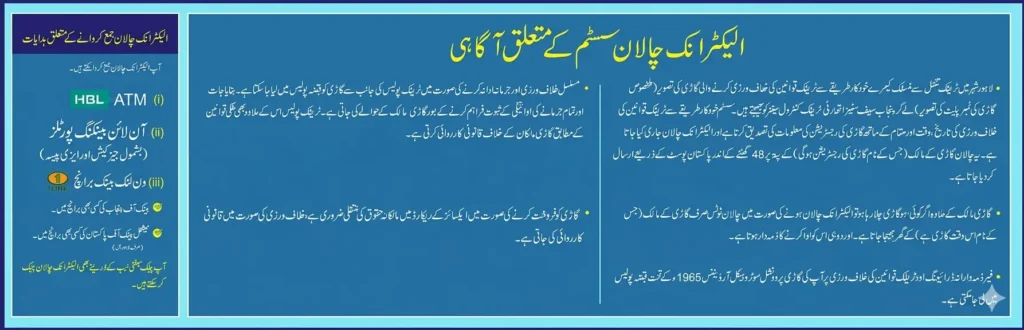
1-Link ATMs:
Insert ATM card → Enter PIN → Select “Bill Payment” → Choose “Traffic Challan” → Enter PSID → Confirm amount → Complete transaction → Print receipt.
National Bank of Pakistan Branches:
Visit any branch → Provide PSID and CNIC → Fill payment slip → Submit cash or account payment → Collect stamped receipt.
Online Banking Portals:
Login to internet banking → Go to bill payments → Select PSCA/traffic challan → Enter PSID → Confirm and pay online.
How to Reprint Your E-Challan?
If you have lost or missed your original e-challan notification, the reprint option makes it easy to recover all details instantly. The system managed by the Punjab Safe Cities Authority allows citizens to access and download challans anytime through the official portal.
To reprint your e-challan, visit and enter your vehicle registration number along with your CNIC. After clicking the search button, all your issued challans will appear on the screen. Find the specific challan you want and click on the “Print” or “Download PDF” option.
The system generates a complete digital copy containing violation details, date and time, location, fine amount, PSID, and photographic evidence (if available). You can save this file on your phone or computer or print it for official use.
This reprinted challan is fully valid for payment at banks, ATMs, mobile wallets, and for use during appeals or verification processes. It carries the same legal value as the original SMS or notification. Keeping both digital and printed copies is recommended to avoid issues during vehicle checks or documentation.
What Are the Common Traffic Violations in Punjab?
Understanding common violations helps drivers avoid unnecessary fines and maintain safe driving habits. Most violations are automatically detected by Safe City cameras and recorded in the digital system.
Signal Jumping:
Running a red light is one of the most common violations. Cameras capture vehicles crossing stop lines after signals turn red. Fines usually start at Rs. 2,000 and increase for repeat offenses.
Wrong Parking:
Parking in restricted zones, no-parking areas, or blocking traffic lanes leads to automatic challans. Repeated violations increase penalties.
Lane Violations:
Improper lane changing, crossing solid lines, or using emergency lanes without permission is strictly monitored. These actions are considered dangerous driving behaviors.
Overspeeding:
Speed detection cameras monitor vehicles exceeding limits. Heavy overspeeding can result in higher fines depending on severity.
No Helmet (Motorcycles):
Riding without a helmet is frequently detected. Cameras can easily identify riders without proper safety gear.
Mobile Phone Usage:
Using a phone while driving without a hands-free system is considered a serious safety violation and is frequently fined.
Zebra Crossing Violations:
Not stopping for pedestrians at crossings results in penalties, especially in busy urban areas.
Modified Number Plates:
Illegal or unreadable number plates can prevent identification and lead to challans or even vehicle detention until corrected.
Carrying Excess Passengers:
Overloading vehicles beyond legal capacity is a safety risk and results in fines and stricter action for repeat violations.
Driving Without License:
Driving without a valid license is a serious offense and can lead to heavy fines and legal consequences. All violations are permanently recorded in your digital driving history.
Each violation becomes part of your record, so repeated offenses can lead to stricter monitoring and higher penalties under Punjab’s traffic enforcement system.
New Traffic Fine Structure December 2025
The Punjab government introduced a major revision in traffic penalties effective December 1, 2025, under the updated enforcement framework. This is one of the strictest reforms in recent years, aimed at improving road safety, reducing accidents, and ensuring full compliance with traffic laws across the province under the supervision of the Punjab Safe Cities Authority.
Below are the key updated sections and penalties:
Section 89A – Number Plate Display:
All vehicles must display clear, approved number plates.
Fine: Rs. 2,000 (first offense), Rs. 5,000 (repeat violation)
Section 89B – Child Seatbelt:
Children seated in the front must wear seatbelts for safety.
Fine: Rs. 2,000 (first offense), Rs. 5,000 (repeat offense)
Section 97 – Driving Without License:
Driving without a valid license is treated as a serious violation.
Fine: Rs. 2,000 initially, Rs. 15,000 for repeat offenses, plus up to 6 months imprisonment
Section 98A – General Traffic Rule Violations:
Covers all basic traffic law violations.
Fine: Rs. 2,000 first offense, Rs. 15,000 repeat, imprisonment up to 6 months
Section 99B – Underage or Careless Driving:
Includes minors driving or reckless behavior on roads.
Fine: Rs. 2,000, repeat Rs. 15,000, imprisonment up to 6 months
Section 105A – Dangerous Vehicle Condition:
Operating unsafe or defective vehicles.
Fine: Rs. 2,000, repeat Rs. 15,000, up to 2 years imprisonment in severe cases
Section 106A – No Fitness Certificate:
Mandatory for commercial vehicles to ensure road safety compliance.
Fine: Rs. 2,000, repeat Rs. 15,000, 6 months imprisonment possible
Section 106B – Excess Passengers:
Overloading beyond vehicle capacity.
Fine: Rs. 3,000 first offense, Rs. 15,000 repeat, imprisonment up to 6 months
Section 112A – Emergency Lane Misuse:
Blocking emergency vehicles by misusing lanes.
Fine: Rs. 2,000, repeat Rs. 15,000, 6 months imprisonment
Section 112D – Modified Lights:
Illegal or excessively bright vehicle lights.
Fine: Rs. 2,000, repeat Rs. 15,000, 6 months imprisonment
Section 112E – Illegal Window Tints:
Using dark or unauthorized tinted windows.
Fine: Rs. 2,000, repeat Rs. 15,000, 6 months imprisonment
These revised fines represent a 400% to 1000% increase compared to previous penalties, reflecting the government’s strict approach toward road discipline and safety enforcement.
DLIMS Digital Record System
The traffic monitoring system is now fully integrated with the DLIMS (Driving License Issuance Management System), which permanently records every violation linked to your CNIC and driving license number.
What DLIMS Records:
- Complete violation history (date, time, location)
- Paid and unpaid fines
- Repeat offense patterns
- License suspension history
- Court-related traffic cases
- Vehicle impoundment records
How DLIMS Affects You:
Your driving record is automatically checked during license renewal. Multiple violations may require additional scrutiny or training before approval. Insurance companies may also review your record before issuing or renewing policies.
Penalty Point System:
Punjab has introduced a points-based system. Each violation adds penalty points, and reaching a high threshold within a year can lead to license suspension for 3 to 12 months.
Clearing Your Record:
Paying fines removes pending status but does not erase violations. However, maintaining clean driving behavior over time improves your record, especially after three years of violation-free driving.
This system is designed to promote accountability and identify repeat offenders while encouraging safer driving habits across Punjab.
What are the Motorcycle-Specific E-Challan Issues?
Motorcycles in Punjab receive a large share of e-challans because they are more exposed to roadside monitoring and Safe City camera systems managed by the Punjab Safe Cities Authority. Many riders unknowingly or repeatedly violate basic traffic rules, which leads to frequent fines.
No Helmet Violations:
This is the most common motorcycle challan. Cameras easily detect riders without helmets. Both rider and passenger must wear approved safety helmets.
Fine: Rs. 2,000 per violation
Carrying Extra Passengers:
A motorcycle is legally allowed to carry only two people. Carrying three or more passengers is dangerous and strictly prohibited.
Fine: Rs. 2,000
Wrong Lane Usage:
Riding between lanes or using improper lanes increases accident risk and is regularly monitored.
Fine: Rs. 2,000
Signal Violations:
Many bikers assume cameras cannot detect motorcycles, but modern systems clearly capture number plates at signals.
Fine: Rs. 2,000 (first offense), Rs. 5,000 (repeat)
Modified Exhausts:
Loud silencers or modified exhaust systems disturb public peace and are penalized by traffic authorities.
Fine: Rs. 2,000
Number Plate Issues:
Unreadable, stylized, or improperly placed number plates prevent identification and lead to fines.
Fine: Rs. 2,000
Motorcycle riders are required to follow the same traffic laws as car drivers. The assumption that bikes are less likely to be caught by cameras is incorrect, as modern surveillance systems clearly detect two-wheelers.
What Happens If You Ignore E-Challan?
Ignoring or delaying e-challan payments can lead to serious legal and financial consequences under Punjab’s strict traffic enforcement system.
Vehicle Token Renewal Block:
Unpaid fines can block your vehicle token renewal process. Excise departments check challan clearance before issuing new registration tokens, making your vehicle legally non-compliant.
Checkpoint Problems:
Traffic police can instantly access your violation history during routine stops. Officers may require immediate payment or take further action based on pending fines.
Accumulated Penalties:
Delaying payments can increase your total payable amount due to added penalties or repeated violation charges.
Court Summons:
Multiple unpaid challans or serious violations may result in court notices, leading to legal proceedings and additional penalties.
Vehicle Impoundment:
In severe cases where fines remain unpaid, authorities may impound the vehicle until all dues are cleared along with additional charges.
License Suspension:
Repeated violations and unpaid fines contribute to penalty points, which may lead to temporary or permanent license suspension.
Credit and Record Impact:
Ongoing discussions around system integration suggest that repeated violations may negatively affect future financial and administrative approvals.
Travel Restrictions:
In extreme legal cases involving court orders, travel restrictions may also be applied.
Overall, the system is designed to enforce discipline strictly—delays in payment only increase the consequences over time.
How to Avoid Traffic E-Challans?
Avoiding e-challans in Punjab is simple if you follow basic traffic discipline and stay alert on the road. Since the system is fully digital and monitored through the Punjab Safe Cities Authority, most violations are captured automatically by cameras—so prevention is the only real solution.
Stop Completely at Signals:
Always stop at red lights without hesitation. Yellow means prepare to stop, not accelerate. Most signal violations happen when drivers try to rush intersections.
Respect Zebra Crossings:
Never block zebra crossings. Always stop behind the line and give priority to pedestrians.
Park Legally:
Only park in designated areas. Avoid no-parking zones, fire hydrants, and places that block traffic flow or emergency access.
Wear Helmets Always:
Motorcyclists and passengers must wear certified helmets on every trip, no matter how short the distance.
Follow Speed Limits:
Pay attention to road signs, especially in school zones, hospitals, and residential areas where limits are lower.
Maintain Proper Number Plates:
Use standard, clearly visible plates. Avoid fancy fonts, stickers, or damaged plates that are hard to read by cameras.
Avoid Mobile Phone Usage:
Do not use your phone while driving. Even checking messages at signals can lead to violations unless hands-free systems are properly used.
Stay in Correct Lanes:
Follow lane markings properly and avoid crossing solid white lines. Emergency lanes are strictly for emergencies only.
Keep Documents Current:
Always carry valid license, registration, insurance, and token tax documents to avoid unnecessary fines during checks.
Avoid One-Way Violations:
Carefully follow road signs instead of relying only on GPS navigation, which may suggest incorrect routes.
Don’t Overload Vehicles:
Respect passenger and weight limits. Overloading is a major safety risk and leads to strict penalties.
Practicing defensive driving and staying aware of traffic rules can help you completely avoid most e-challans.
Can You Appeal a Wrong E-Challan?
Yes, Punjab allows citizens to challenge incorrect e-challans if there is a genuine mistake in the system. Since all violations are digitally recorded by the Punjab Safe Cities Authority, appeals are only accepted when valid proof is provided.
Valid Reasons for Appeal:
- Wrong vehicle captured due to cloned number plate
- Vehicle was stolen and FIR was registered
- Camera misread number plate digits or letters
- Vehicle was sold before violation date
- Incorrect vehicle type, color, or image mismatch
Online Appeal Process:
- Download the PSCA app (if available)
- Open “Complaint Management” or e-challan section
- Enter vehicle number and challan ID
- Select dispute reason
- Upload supporting images or documents
- Submit complaint and save reference number
- Wait for verification (usually 15–30 days)
In-Person Appeal Process:
- Visit PSCA office (e.g., Qurban Lines, Lahore) or local traffic office
- Bring CNIC, vehicle registration, and challan copy
- Submit written application with evidence
- Provide supporting documents (FIR, sale deed, etc.)
- Officers verify with camera footage
Required Documents:
- Original CNIC + copy
- Vehicle registration documents
- Printed e-challan copy
- FIR (if stolen vehicle case)
- Sale documents (if vehicle sold)
- Proof photos showing mismatch
Frequently Asked Questions
Q. How often should I check my e-challan status?
It is recommended to check your Punjab e-challan at least once every month. Regular checking helps you avoid missed fines, penalties, and registration issues linked with the Punjab Safe Cities Authority system.
Q. Can I pay multiple challans together?
Yes, you can pay multiple e-challans in a single transaction through mobile wallets, banks, or the PSCA portal by selecting all pending fines and using your PSID numbers.
Q. Do e-challans expire?
No, e-challans do not expire. They remain active until paid and continue to affect your vehicle record and renewal process.
Q. What if I sold my vehicle but challans still appear?
You should transfer ownership immediately through the Excise Department. Until official transfer is updated, challans remain linked to your old registration record.
Q. Can I check someone else’s vehicle challan?
No, you generally need vehicle registration details and CNIC/chassis number. The system is designed to protect owner privacy.
Q. Are camera challans mandatory to pay?
Yes, all valid camera-issued e-challans must be paid as they are legally enforceable under Punjab traffic laws.
Q. What happens to foreign-registered vehicles?
Foreign or out-of-province vehicles are also subject to fines if violations occur within Punjab. Clearance is required before exit or further travel.
Q. Can traffic wardens still issue manual challans?
Yes, traffic wardens can still issue manual challans for on-spot violations that may not be captured by cameras.
Conclusion
Punjab’s e-challan system represents a major shift toward digital traffic enforcement, managed through the modern surveillance network of the Punjab Safe Cities Authority. With automatic monitoring, instant violation recording, and strict penalty enforcement, the system ensures greater transparency and accountability on roads.
For drivers, the key to avoiding fines is simple—follow traffic rules, stay alert, and regularly check your e-challan status online. Ignoring violations can lead to serious consequences like blocked vehicle registration, legal penalties, and license issues.
Ultimately, the system is not just about fines—it is designed to improve road safety, reduce accidents, and promote responsible driving across Punjab. Staying informed and compliant is the best way to keep your driving record clean and stress-free.